
The Future of Work

Going up?
The world of work is changing faster than many can manage. AI is automating roles at scale, climate disruption is shifting where populations live, and aging demographics are rewriting economic needs. Amidst this volatility, the traditional employment ladder—which once promised stability in exchange for loyalty—is dissolving under the weight of mass layoffs. In its place, we see the rise of portfolio careers, fractional contracts, and a generation of graduates entering one of the toughest entry-level markets in decades.
Beneath all of this lies a question that economic models have never been particularly good at answering: what is work actually for?
To dig into the future of work without getting lost in philosophy, we must ground ourselves in three present-day signals. When connected, these signals reveal a counter-intuitive reality: the tech revolution is proving that the future of work is deeply, inherently human.
Emotional Availability
Our first signal focuses on the skills we will need to survive. While technical automation dominates headlines, the World Economic Forum is unambiguous: the capabilities most in demand in an AI-augmented workplace are empathy, judgment, and communication. True value now lies in the ability to retain calm despite complexity and to act decisively.
We are already seeing the friction that occurs when companies try to automate these human traits. Take the case of Klarna. After laying off 700 employees in favor of AI, the company quietly began rehiring human agents, citing quality concerns and customer dissatisfaction. As CEO Sebastian Siemiatkowski later acknowledged, efficiency metrics look great on paper, but customers still demand the assurance of a human being when things go wrong.
Klarna is not alone in hitting this tech wall. A recent IBM survey of 2,000 CEOs revealed that just one in four AI projects actually delivers its promised return on investment. The bold predictions of AI replacing human judgment are falling short of the hype, precisely because code cannot replicate emotional availability.
Corporate Amnesia
This gap between corporate expectation and human reality is fundamentally changing the shape of careers. As job security erodes, we are seeing a structural shift toward portfolio and fractional work. This is particularly true for mid-career women, who have been systematically underserved by rigid corporate systems that fail to support maternity leave or conflate physical visibility with actual value. For them, and for older employees looking to sustain longer lifespans, fractionality is not a pursuit of instability. It is a deliberate design choice for a system that resists the needs of real people.
However, as experienced professionals move toward independent portfolio careers, the corporate talent pipeline is beginning to fracture from the bottom up.
This pipeline matters considerably more than organizations appreciate. The repetitive activity and skill-building of early careers cannot be replicated in a classroom; entry-level roles are a specialized crash course that keeps a firm's institutional knowledge intact. Yet, 62% of UK employers expect junior, clerical, and administrative roles to be the first lost to AI. By cutting these roles, companies are suffering from a form of corporate amnesia. They do not just lose the person; they lose what that person would have learned, and what they would have eventually taught the people working with them.
The Paradox of New Markets
This lack of foresight brings us to our third signal: where the jobs are going, and why we lack the people to fill them.
The green transition and the security transition are both creating urgent, undersupplied demand for human skills. For the first time, the electricity sector has surpassed fossil fuels as the largest energy employer globally. Yet, more than half of energy firms report critical hiring bottlenecks. To prevent this skills gap from widening further by 2030, the number of qualified new entrants must rise by 40%. We see a parallel crisis in cybersecurity, where AI adoption has accelerated criminal activity—like deepfakes and automated fraud—outpacing the supply of trained professionals.
When we look at these three signals together, the irony is hard to miss. AI is simultaneously eliminating certain roles and generating acute shortages in others. Yet, by prematurely automating entry-level positions, organizations are systematically eroding the very pipeline through which people develop the expertise required to fill these new, critical roles. The future of work will not belong to the most automated companies, but to those that figure out how to cultivate human talent before the pipeline dries up entirely.
The Context and Tensions
Escape or change?
Europe has just endured its second severe heatwave in two months, with records broken in France, Spain, the UK and beyond. Climate disruption is not a future concern. It is a present-tense operating condition, reshaping where people can live and work and driving migration patterns that are already rewriting the composition of workforces across the continent.
At graduation ceremonies across the United States this spring, commencement speeches praising AI were met with boos from students entering one of the toughest entry-level job markets in years. 81% of Gen Z believe AI will decrease job opportunities. Only 5% of Americans feel AI development is being led by people or organisations that represent their interests. That is not technophobia. That is a rational response to a real situation, from a generation that has watched the entry-level roles they trained for disappear, while being told to be excited about the technology replacing them.
All of this is happening at the same moment that SpaceX's IPO made Elon Musk the world's first trillionaire, and Oxfam estimates there will be five trillionaires within a decade. The trajectory of wealth concentration and the trajectory of work are not separate conversations.
What Needs to Change

Click for change
The question is not whether to adopt AI to eradicate all jobs and automate the world. It is how to work with and transition to emerging technologies, and in whose interest, and with what theory of what work is actually for.
There is a better model, and it already exists.
When IKEA introduced an AI chatbot that handled nearly half of all customer queries, rather than cutting the 8,500 people whose roles changed, the company retrained them as interior design consultants — roles that built on their existing knowledge of customers and product. The remote design channel now generates over €1.3 billion annually. What had been a cost centre became a revenue line. And critically, when frontline staff see AI as a route to a better role rather than a threat to their current one, adoption accelerates and resistance drops. The IKEA story is not perfect — the company has since made office-based redundancies in a separate restructure — but the strategic direction is right. Automation identified what people did not need to be doing. Human capability was redirected toward what people are actually good at.
And that human-centred approach is what makes the difference. Afterall, people are all we’ve got. The decision about what to automate should not come from above, optimising for headcount reduction. In creative organisations especially, the people doing the work are best placed to identify what they would rather not be doing e.g. repetitive, admin tasks, and to redirect that time toward work that requires genuine human intelligence. AI adoption in creative teams should start with the question: what do people here wish they spent less time on? Not: what can we eliminate?
The goal is not efficiency for its own sake. It is to make work more human, more creative and more purposeful. AI should expand what people are capable of, not compress it.
There is a second, deeper argument that work is, at its heart, really about Care. Creative work, artistry, craftsmanship, and care for children, elders, and each other are not soft supplements to a productive economy. They are the economy, in any version worth building. The reason they are chronically undervalued is structural and largely gendered: most of this work is performed by women, much of it for free, and almost none of it shows up in GDP. Any honest conversation about the future of work must address this.
The future cannot be human-centred if half the work that makes human life possible remains invisible.
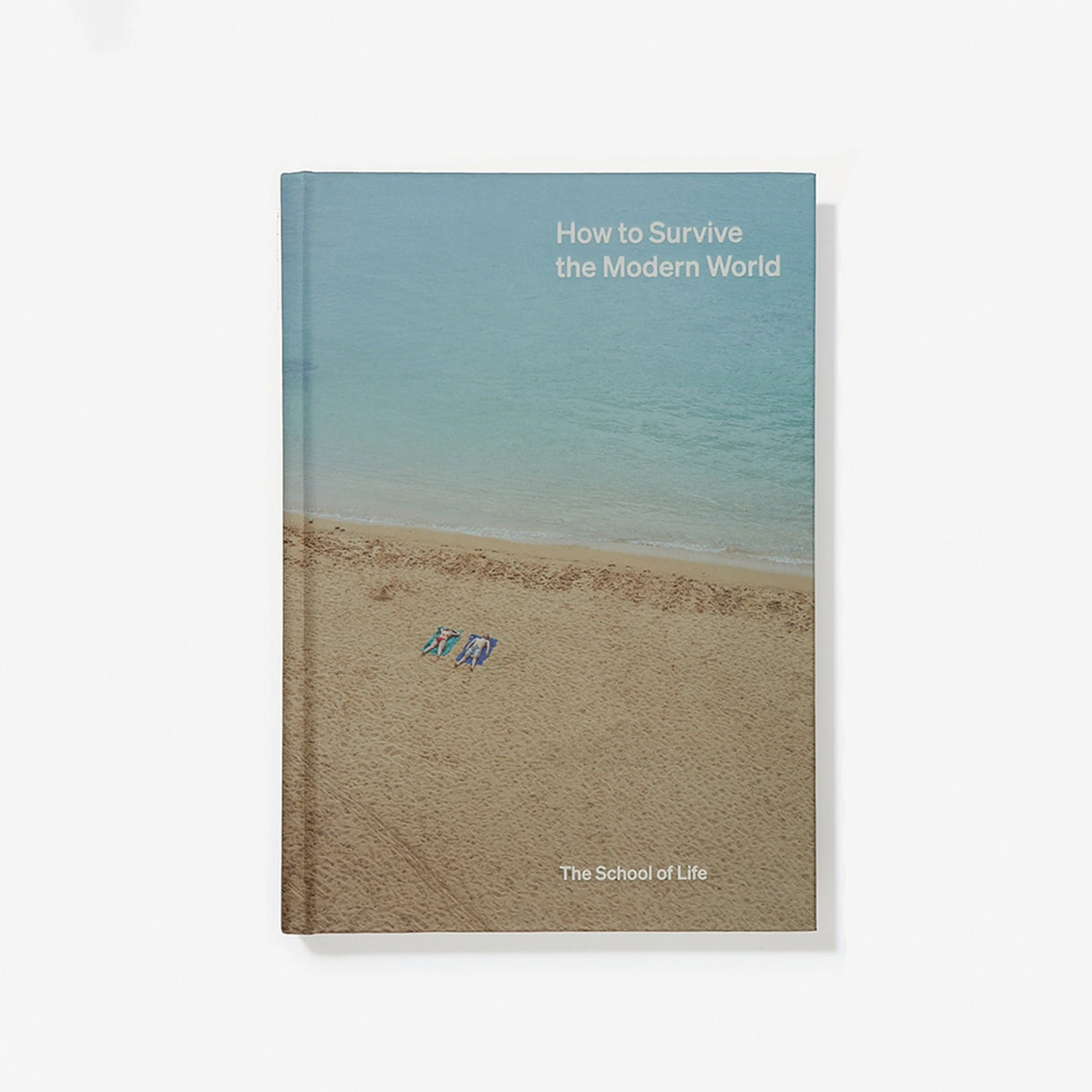
How to Survive The Modern World by The School of Life
“Work is touching to behold when we see a wide variety of people, of different ages and temperaments, physical builds and capacities, united by a single aim; for example, when a gruff handyman, dour accountant, cheery instructor, bland marketing agent, severe government inspector and temperamental cook all come together to create the tool we call a school or a kindergarten.Given what we know of human nature — how conflictual, tricky and individual we can be — it is redemptive to see that we are also capable of laying aside our differences in the name of a unitary mission.Each of us considered singly may not be impressive, but we can rise to the grandeur of the projects we collectively engage in: a cathedral turns the humblest stonemason into a servant of the sublime.”
People want to work. The frustration is not with work itself but it is with a version of it that is increasingly stripped of craft, progression, and the sense that it is in service of something worth building.
The future of work is the answer to the question: what does the world need from us?
As the adults in the room, what actions do we need to help in service to future entry-level job seekers?
If AI absorbs the administrative work that used to train the next generation, what replaces it?
What would a green energy and security workforce transition look like if inclusion was the design brief, not an afterthought?
What does your team actually not want to be doing, and what would they do with that time back?
When we talk about the future of work, whose future are we imagining?
Good Futures No.02 on The Future of Work took place on 2 July at Second Home Mercado, Lisbon.