
Reading Nørrebro: City Scanning at Future Days Copenhagen
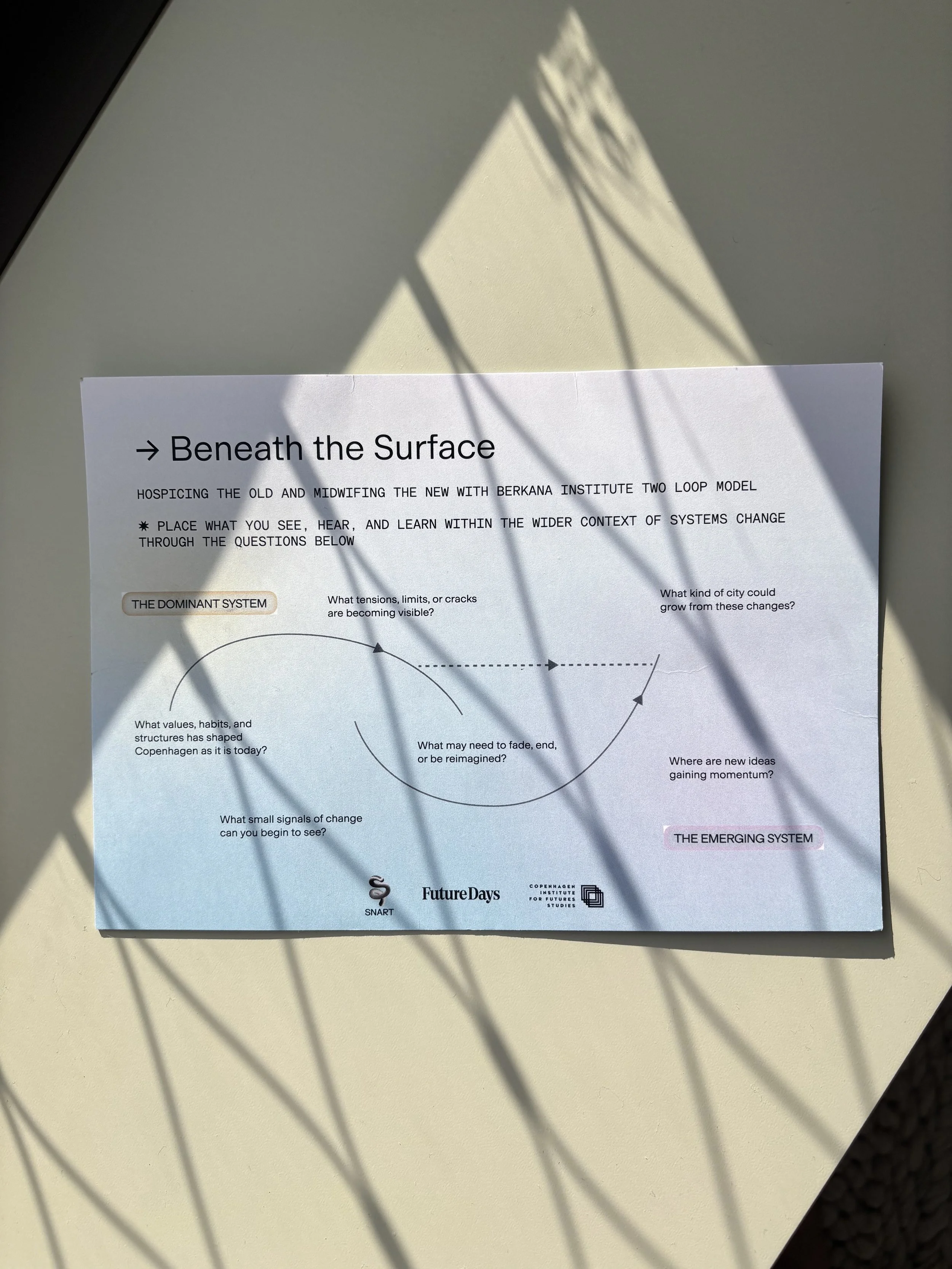
The Two Loop Method for Systems Change by Berkana Institute
Background
Future Days Copenhagen brings together people working across health, innovation and futures from organisations including PwC, H&M Foundation, WHO and Noun. The brief was to co-facilitate a City Scanning walk through Nørrebro using the Berkana Two Loop method, with a group of around 30 participants.
The Challenge
A City Scanning walk works when the group has enough context to read what they're looking at e.g. the history, the tensions, the lived experience of locals that aren't visible on the surface. With limited time to prepare and an unfamiliar neighbourhood, the job was to research the route and build enough grounding in each location to turn a walk into something people could really dig into and experience, on the day.
The Approach
The route walked through three stops, each chosen to surface a different tension in the city, and to challenge the picture-perfect perception outsiders might have of Copenhagen as a progressive utopia. It opened at Demokrati Garage with a talk from Mathias at Anticipate Studio, before walking onwards through Superkilen — an award-winning public space that doesn't necessarily reflect what the neighbourhood's residents actually wanted or needed.
At Assistens Cemetery, we spoke to its history as a green, lively burial ground originally built for the poor, now home to traditional figures from Hans Christian Andersen to Kierkegaard (with a nod to Kierkegaard's line that anxiety is the dizziness of freedom).
The City Scanning walk closed at Folkets Hus, a self-managed, horizontally democratic squatted house and park running inclusive community activities since 1971, before the group moved on to the Future Days opening event at Thoravej 29.
At each stop, the group was prompted to consider their surroundings in the context of the Berkana Institute’s Two Loop Model, asking what's ending, what's emerging, and what's enduring. At each point we discussed how we were understanding the location and tension points we could see.
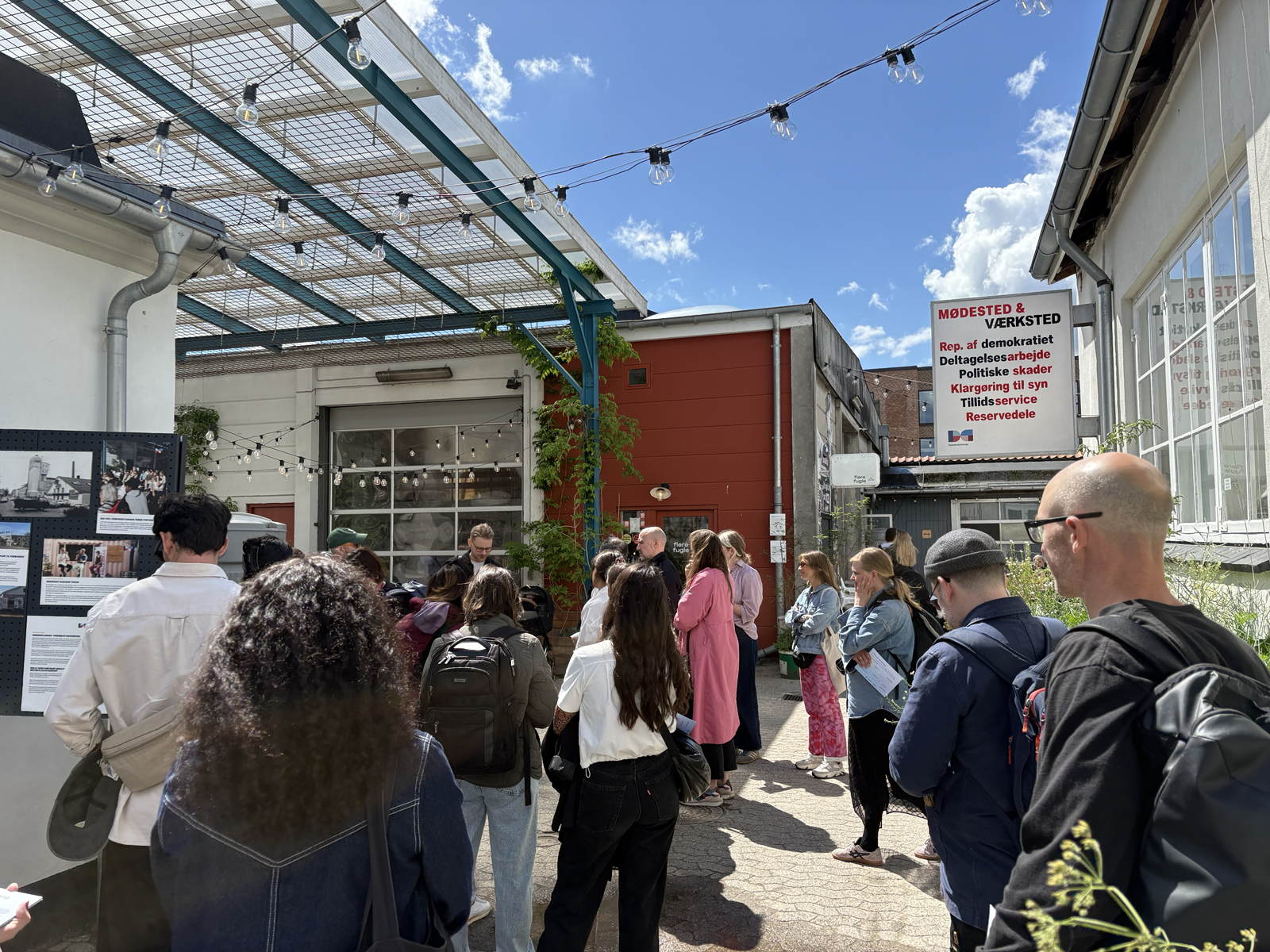
Demokrati Garage
The Results
The framing was well recieved and understood as a provocation for thinking more critically about the cities we walk through in advance of the Future Days event.
Participants surfaced sharp, specific reflections: that the dominant perception of Copenhagen as clean, green and perfectly progressive is ending; that the gap between the people who design spaces and the people who use them endures; and that visible wear, use and adaptation where the city looks less pristine than its reputation is beginning to emerge.
Feedback from the group was positive, and the walk gave them a shared lens for the rest of the Future Days programme, not just a list of interesting places.
Key Learnings
Walking a city is sense-making and rare in the context of conferences. Designing and developing space for participants to think more critically in advance, gave a shared framework and green light to dig beyond the surface.
The ability to design and hold a structured experience for a large group of strangers, at short notice, in unfamiliar territory, and turn observation into something people leave with is the same muscle that runs a Curious Futures workshop or a Good Futures evening.
Interested in running an experiential session with your team? Get in touch at nouvot.co